

Musical Katha by Rajiv Jain CA brings alive saga of Pawapuri, message of Ahimsa from horrors of war, and Nirvana Utsav illuminated with thousands of lamps
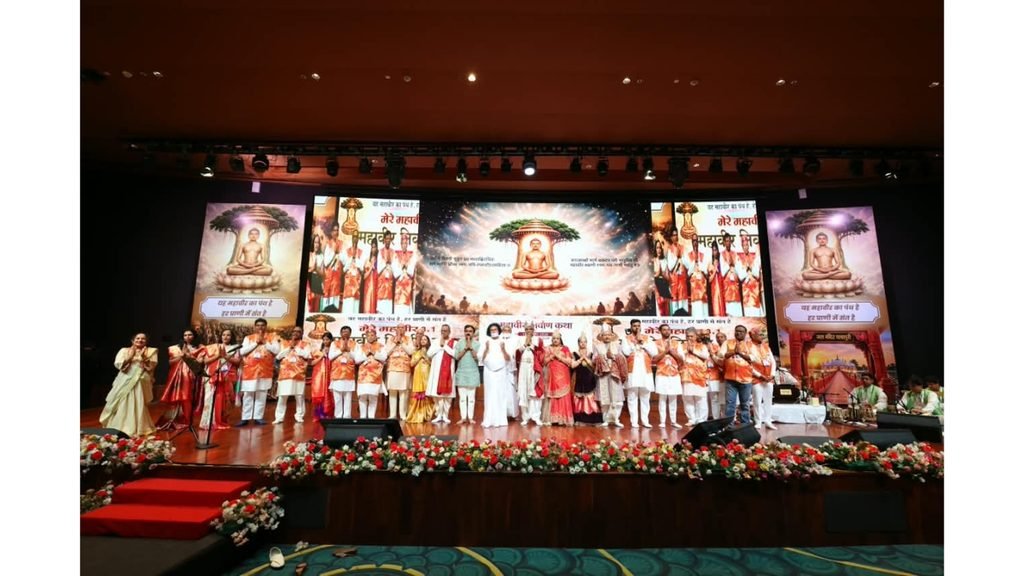
New Delhi [India], November 16: In a joint initiative by Bhagwan Mahavir Deshna Foundation and BRJ Productions, ‘Mahavir Nirvana Katha – Mere Mahavir 3.1’ was staged at Bharat Mandapam on Sunday. Shri Rajiv Jain CA, through his narration, original music and visual presentation, brought alive the nearly 2552-year-old Pawapuri and the final chapter of Lord Mahavir’s life before the audience. The audience was seen deeply moved in many episodes of the Katha.
To listen to the Katha, Founder of Ahimsa Vishwa Bharati, Pujya Acharya Lokesh Muni Ji, his associate Sant Shri Adarsh Muni Ji and Chairman of National Commission for Scheduled Castes, Shri Kishor Makwana Ji were present as special guests. They enjoyed the entire Katha. Their presence was associated with the spirit of taking Lord Mahavir’s message of Ahimsa and compassion to the wider society.
At Bharat Mandapam, glimpses of ancient Pawapuri and episodes related to Lord Mahavir’s life were shown. Visitors were welcomed with Kesar Tilak and lamps were gifted for Deepotsav. After Mangalacharan, the scene of Lord Mahavir’s final Chaturmas and Samavasaran at Pawapuri appeared on the LED screen. Nominated Municipal Councillor Shri Manoj Kumar Jain played the role of King Hastipal and Shri Sudhir Jain played the role of King Nandivardhan. With dialogues of these characters, the Katha moved towards Mahavir’s birth, childhood, youth, renunciation and initiation.
Lord Mahavir’s thoughts on equality, freedom and right to existence of every living being were also explained in the context of modern values enshrined in Article 14, 19 and 21 of the Indian Constitution. The journey of twelve and a half years of rigorous penance, silence, non-violence and Kevalgyan was presented through music and visuals. With the message of ‘Ye Mahaveer Ka Panth Hai, Har Prani Me Sant Hai’, it was conveyed that every living being has the possibility of spiritual development and reaching the supreme state.
The episode of Chandanbala was a poignant part of the Katha. The war between King Shatanik of Vatsa, Kaushambi and King Dadhivahan of Champa, the devastation caused by it and its impact on innocent people were shown through visuals. Through Chandanbala’s pain, the question was also raised as to why innocent human beings have to pay the price for lust for power, hoarding and violence. Linking this episode with the wars and conflicts going on in the world today, the relevance of Mahavir’s thoughts of Ahimsa and Aparigraha was explained. The scene of Lord Mahavir accepting alms from Chandanbala’s hands after five months and twenty-five days was a particularly emotional moment for the audience.
In the dialogue between King Shrenik, known in history as Bimbisara, and Lord Mahavir, the doctrine of Karma, hellish existence and the Jain belief of becoming a Tirthankar in future were explained in an interesting manner.
After this, the Katha again reached Pawapuri. In Lord Mahavir’s final sermon, subjects like Jiva-Ajiva, doctrine of Karma, food, purification of soul, freedom from attachment and path to liberation were presented with simple examples.
Explaining the pleasures and sorrows of Dev, Manushya, Tiryanch and Narak – these four states of existence, special discussion was held on the importance of human birth. It was explained that in Jain philosophy, human life is valuable because it is in this state that one gets the opportunity to stop the bondage of new Karmas through discretion, penance, restraint and self-effort, to shed accumulated Karmas and to move towards Moksha. The message of the Katha was that instead of waiting for death, a human being should understand the purpose of his existence while alive.
The scene of Gautam Swami’s self-contemplation journey and attainment of Kevalgyan after Lord Mahavir’s Nirvana was also very emotional for the audience.
The narrator and Creative Director of the Katha, Mrs. Abhisha Jain, connected various episodes through her dialogues. Original compositions of Music Director Shri Pradeep Jain gave the entire Katha a musical form. At the conclusion, Nirvana song, Deepotsav with thousands of lamps and Aarti of Lord Mahavir made the entire atmosphere devotional.
The program was live telecasted on television and YouTube channels across India and abroad. The Katha prominently highlighted the messages of Ahimsa, Anekant, Samata, Aparigraha and environmental protection along with vegetarianism, good conduct and de-addiction.
In making this event successful, there was a special contribution from Director of Bhagwan Mahavir Deshna Foundation, Shri Subhash Oswal Jain, Shri Manoj Jain, Shri Rajiv Jain CA and Shri Anil Kumar Jain CA, Honorary Host Shri Satyabhushan Jain and Regional Directors Shri Manish Jain, Mrs. Christy Jain and Shri Shubham Jain. The presentation was realized by Mrs. Beena Jain, Founder and Producer of BRJ Productions, Co-producers Mrs. Varshu Jain and Advocate Manibhadra Jain.
If you object to the content of this press release, please notify us at [email protected]. We will respond and rectify the situation within 24 hours.